
Yes, but monk fruit extract is not one ingredient. It reaches buyers in three working formats: a high-potency extract powder, a concentrated juice, and a blend sweetener built to measure and taste closer to sugar. Your reduction target and the jobs sugar still performs in the formula decide which format to sample first.
This guide shows how to map a reduction target to a format, choose a Mogroside V grade, and confirm the sensory, regulatory, and documentation evidence before you request a sample.
Most sugar reduction projects begin with a percentage, and that is where they often go wrong. A 30 percent reduction keeps most of the sugar in the formula, so the sweetener only has to top up sweetness. A zero-sugar claim removes the sugar entirely, which means the sweetener must replace sweetness while something else replaces bulk, browning, mouthfeel, and shelf behaviour. The two projects need different monk fruit formats, and they are validated against different acceptance criteria.
| Reduction target | Format to sample first | What the format solves | What still needs solving |
|---|---|---|---|
| Full removal or a zero-sugar claim | High-potency extract powder at a defined Mogroside V grade | Sweetness at a very low addition level, with sugar calories removed from the sweetness function. | Bulk, texture, browning, and structure still need a bulking agent, fibre system, or process change. |
| Partial reduction, roughly 25 to 50 percent | High-potency extract powder, usually a lower grade | Replaces the sweetness of the sugar removed while most of the sugar stays to carry body. | Sweetness curve matching. Onset and lingering can differ from sucrose even at equal perceived intensity. |
| Sugar-like dosing in table sugar, candy, or bakery | Monk fruit blend sweetener at 1 to 4 times sugar | Familiar measuring and dosing for production staff and for the consumer. | The ingredient declaration now carries the blend carrier. Check the carrier against your claims. |
| Liquid systems that already handle juice or syrup | Monk fruit concentrated juice | Liquid dosing with no powder dispersion step, and a published pH window for acidic systems. | Sweetness per unit is low, so both dose volume and added solids rise in the formula. |
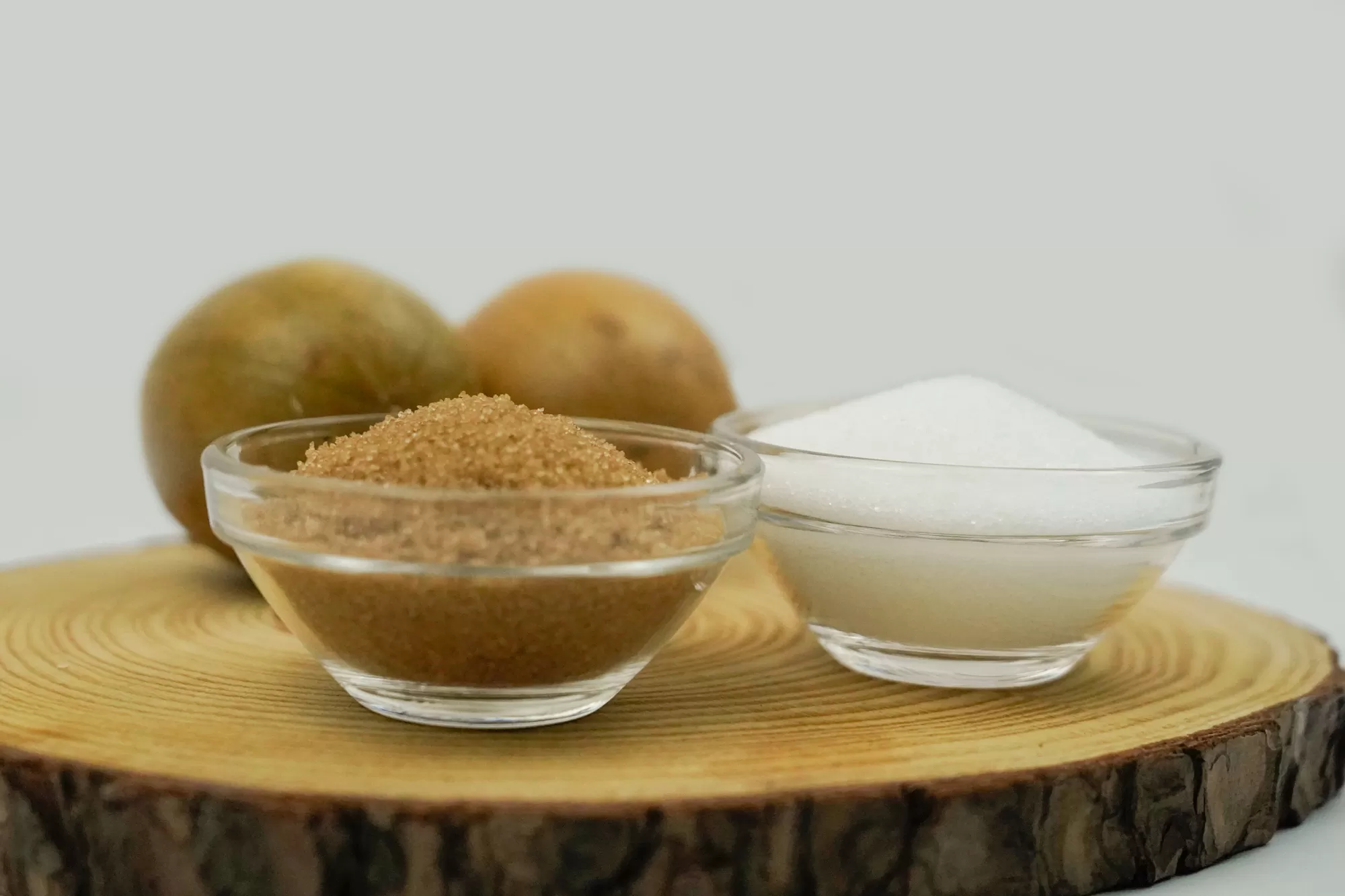
The three formats are not three grades of the same material. They differ in Mogroside V concentration, sweetness multiple, physical form, and therefore in the formulation problems they can solve. Huacheng Bio offers all three in the H2-Luo range, so a buyer can compare specification sheets side by side before requesting samples.
| Format | Published specification | Sweetness against sugar | Fits best | Does not solve |
|---|---|---|---|---|
| H2-Luo Monk Fruit Extract | Mogroside V 1.5% to 98%; published grades V20, V25, V40, V50, V55, and V90; passes 80 mesh | High intensity, set by the Mogroside V grade | Formulations that must deliver sweetness in a small dose, including beverages and nutritional supplements | Bulk, browning, and texture. These remain separate formulation problems. |
| H2-Luo Monk Fruit Concentrated Juice | 1% to 10% Mogroside V by HPLC; pH 3.5 to 7.0 at 65 to 70 brix; pesticide residues stated as conforming to GB2763 and USP36 | Published per item: 1, 1.5, 3, 8, and 18 times sugar | Beverages, dairy products, and processes that dose a liquid sweetener | Applications that need the sweetness concentration of a purified powder. |
| H2-Luo Monk Fruit Blend Sweetener | 1 to 4 times sugar; offered with erythritol, stevia plus erythritol, allulose, or dietary fibre | 1 to 4 times sugar | Table sugar, candy, drink mixes, and baking where sugar-like dosing matters | A monk-fruit-only ingredient declaration. |
The practical trade-off sits between concentration and control. A high-potency powder lowers the dose, the freight weight, and often the cost in use, but it also tightens weighing tolerance, makes dispersion errors more visible, and leaves every non-sweetness function of sugar unresolved. A 1 to 4 times blend behaves like sugar on the bench and in the plant, but it puts a carrier on your label and the carrier brings its own tolerance and claim considerations. Neither option is better in the abstract; the reduction target and the label you intend to print decide it.
Natural origin is a statement about the source, not about market access. Monk fruit extract comes from the fruit of Siraitia grosvenorii, and the sweet compounds are mogrosides, with Mogroside V used as the marker in published specifications. That origin supports a plant-based positioning. It does not by itself grant regulatory clearance in every market, and it says nothing about flavour neutrality or about what else the sweetener system has to contain.
In the United States, Luo Han Guo fruit extract has been through the FDA GRAS notice process more than once. GRN 301 was filed in 2009 and closed in January 2010, GRN 359 was filed in 2010 and closed in April 2011, and FDA responded that it had no questions in each case. Huacheng Bio is the notifier of GRN 556, filed in December 2014 and closed in June 2015, with the same FDA response. That notice covers the notified substance and its intended use, so read it against your own finished product category and use level before relying on it as a blanket approval.
The European position is different. Monk fruit extract is treated there as an unapproved novel food, and EFSA concluded in 2019 that the submitted data were not sufficient to complete a safety assessment. US GRAS status does not transfer to the EU. Public summaries also describe monk fruit extract as permitted in more than 60 countries without an established acceptable daily intake. Both of those points move over time, so confirm the current position for your specific market, product category, and use level with your own regulatory reviewer before you commit to a launch date.
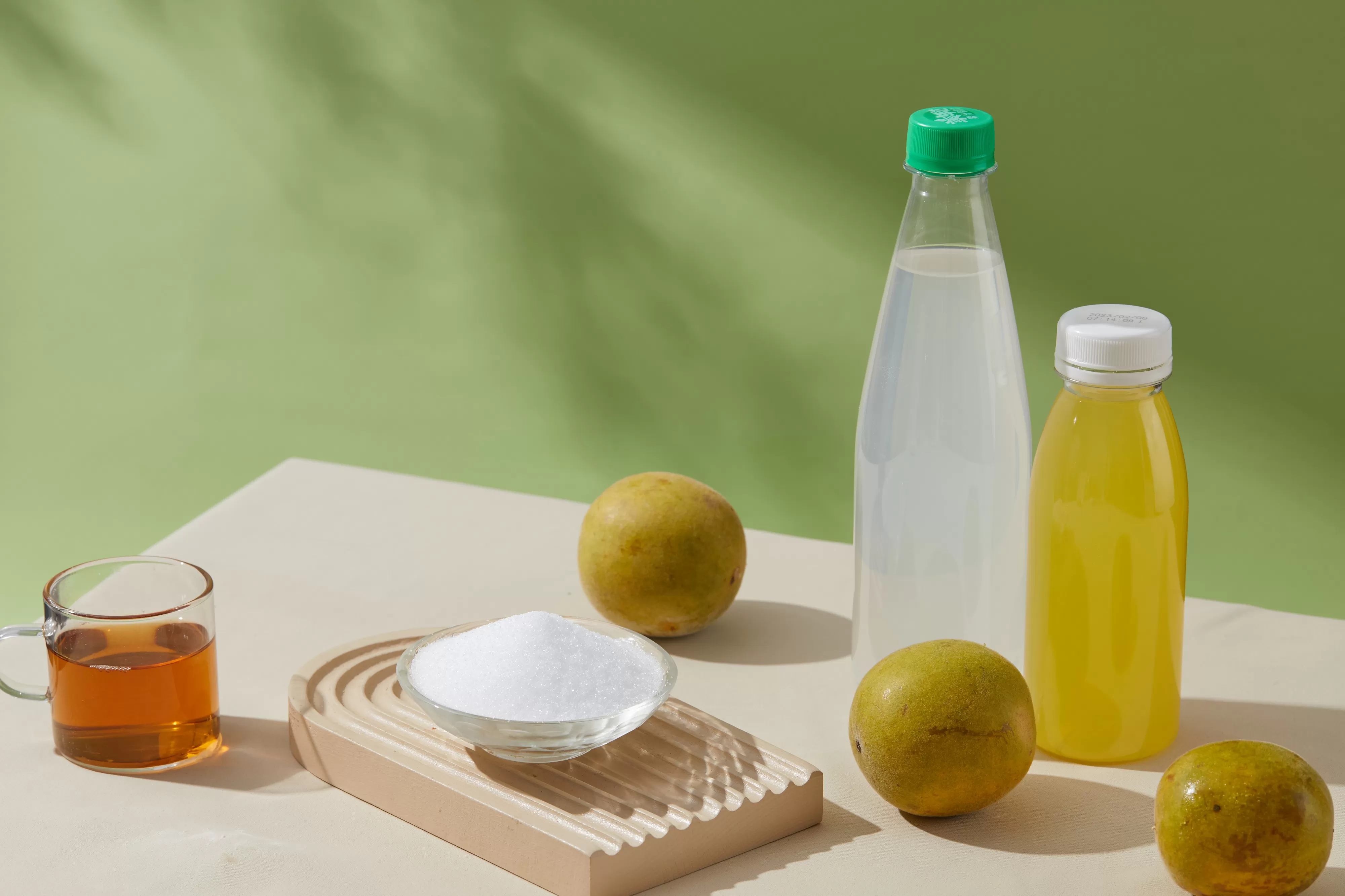
The published H2-Luo grades run from V20 through V25, V40, V50, V55, and V90, within an overall Mogroside V specification of 1.5% to 98%. Treat that list as a set of dosage options; the Mogroside V percentage on its own tells you little about finished-product quality. A V90 material adds far less powder for the same sweetness than a V20 material, which changes weighing accuracy requirements, dispersion method, and how visible a dosing error becomes in the finished batch.
Compare candidate grades at matched sweetness in your own base formula, not by reading percentage numbers on a specification sheet. Record the sweetener addition rate, the preparation method, the lot identifier, and the sensory result together, so a later commercial lot can be checked against the sample that passed. Where the project is a partial reduction, a lower grade is often easier to handle because the addition rate is larger and less sensitive to scale error.
Monk fruit sweeteners are described in published technical summaries as stable at high temperatures, which is why baked goods are a common target. Treat that as a starting hypothesis and validate it under your own time, temperature, and pH conditions, because your process is the only one that has to work. If you are evaluating the concentrated juice, note the published pH window of 3.5 to 7.0 at 65 to 70 brix and confirm stability across the acidity range of your own beverage base.
Sweetness is the easy part. What breaks a reduction project is everything sugar was quietly doing: remove a large share of it and you change solids, freezing point, browning, crumb structure, and mouthfeel at the same time. Blends with erythritol, allulose, or dietary fibre exist to put some of that back, and each carrier carries its own labelling, tolerance, and regulatory position that your team has to review. Run the sweetness trial and the structure trial together, with a sucrose control, and set the acceptance threshold before anyone tastes the first sample.
Huacheng Bio holds certifications including NSF-cGMP, ISO9001, ISO22000, BRC, SC(QS), TUV, GRAS, Non-GMO Project, KOSHER, and HALAL, and its quality system documentation describes the laboratories and third-party arrangements behind them. For supply continuity, Huacheng Bio produces Mogroside V 50% at a total capacity of 650 tonnes per year. Also, Huacheng Bio offers a free sample of 10 to 20 g or an amount sufficient for testing.
Send your reduction target and the jobs sugar still performs in your formula. We can then confirm which H2-Luo format and Mogroside V grade to sample, what documentation is available for that grade, and what your trial needs to prove before a commercial lot is quoted.
Request a format and grade reviewIt is derived from the fruit of Siraitia grosvenorii, and the sweet compounds are mogrosides, so a plant-based or naturally derived positioning is supportable. A natural origin claim does not decide regulatory status, flavour performance, or what else has to appear on your ingredient declaration. Confirm claim wording against the rules in your target market before artwork is approved.
It can remove the sweetness function of sugar. It does not replace bulk, browning, texture, or preservation. A zero-sugar target usually needs a sweetener system: a high-potency monk fruit grade for sweetness plus a bulking agent or fibre for the physical functions. Validate both parts in the finished matrix.
Match it to the reduction target. Use a high-potency powder for full removal or partial reduction, the concentrated juice when your process already doses a liquid sweetener, and a blend when production needs sugar-like measuring. The H2-Luo range from Huacheng Bio covers all three, so a single enquiry can compare them.
Start from your addition rate and weighing accuracy, then confirm at matched sweetness in your own base. The H2-Luo grades run V20, V25, V40, V50, V55, and V90 within a 1.5% to 98% Mogroside V specification. Ask for the current specification and HPLC test method for whichever grade is proposed.
Not on the strength of one approval. Luo Han Guo fruit extract has FDA GRAS notices including GRN 556, notified by Huacheng Bio, where FDA responded that it had no questions. In the EU it is treated as an unapproved novel food and EFSA found the 2019 data submission insufficient. Confirm the current position for your category and use level in each market.







 EN
EN EN
EN CN
CN ES
ES PT
PT SV
SV DE
DE TR
TR FR
FR AR
AR BG
BG HR
HR CS
CS DA
DA NL
NL FI
FI EL
EL HI
HI IT
IT JA
JA KO
KO NO
NO PL
PL RO
RO RU
RU CA
CA TL
TL IW
IW ID
ID LV
LV LT
LT SR
SR SK
SK SL
SL UK
UK VI
VI SQ
SQ ET
ET GL
GL HU
HU MT
MT TH
TH FA
FA AF
AF MS
MS GA
GA BE
BE UZ
UZ